Left Wag, Right Wag:
What Your Dog's Tail Is Really Telling You
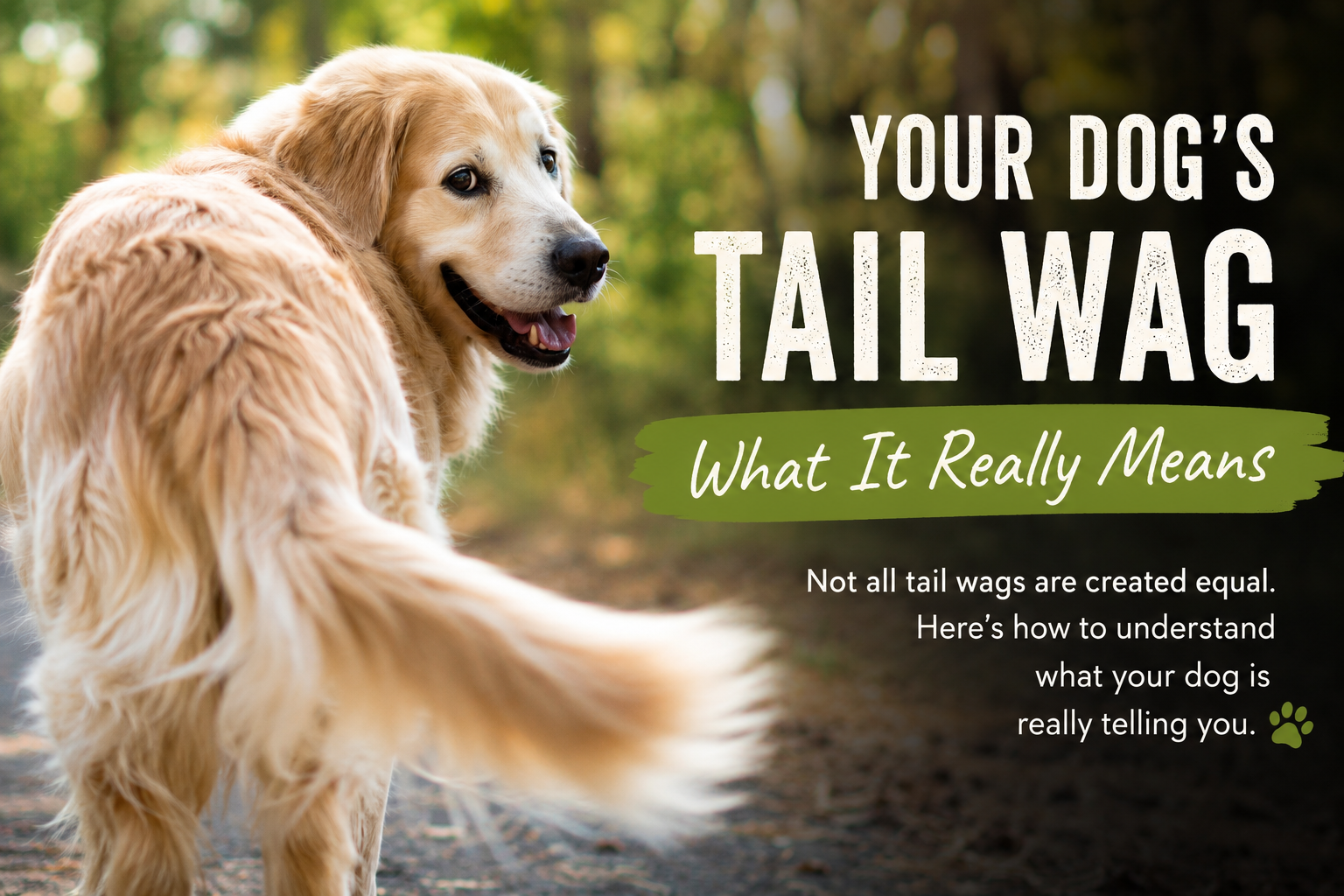
We've all seen it. Two dogs meet at the park, tails going a mile a minute, and somehow it still turns into a snarl-fest thirty seconds later. The owners are baffled — "but his tail was wagging!" Here's the thing: a wagging tail has never meant "happy." It means "I have feelings about this," and which feelings depends entirely on which direction that tail is swinging.
This isn't a training tip or an old wives' tale. It's a real, peer-reviewed finding from a neuroscience lab in Italy — and once you know it, you genuinely cannot unsee it at the dog park.
The Study That Started It All
In 2007, a team led by Giorgio Vallortigara at the University of Trento, working with Angelo Quaranta and Marcello Siniscalchi at the University of Bari, published a study in Current Biology that measured something nobody had really looked at before: which side of the body dogs favoured when wagging their tails, and whether it meant anything.
They studied 30 dogs and showed them four types of stimuli — their owner, an unfamiliar human, a cat, and an unfamiliar dominant dog. The results were strikingly consistent. When dogs saw something that made them want to approach — their owner, mostly — their tails swung with a bigger amplitude to the right side of their body. When they saw something that triggered a withdrawal response — an unfamiliar, dominant-looking dog — the bigger swings shifted to the left.
Left brain hemisphere activation
Right brain hemisphere activation
This wasn't random noise in the data either — the bias held up consistently whether the "approach" stimulus was high-intensity (the owner) or low-intensity (a cat). The direction of the wag tracked the type of emotional response, not just how excited the dog was.
This connects to a much older idea in neuroscience: the left side of the brain tends to be associated with approach-type emotions, while the right side leans toward withdrawal-type emotions. Since each hemisphere controls the opposite side of the body, a left-brain "approach" signal shows up as a right-side tail swing — and vice versa.
Wait — Other Dogs Can Actually Read This?
Here's where it gets really interesting. A follow-up study in 2013 by Siniscalchi, Lusito, Quaranta, and Vallortigara — published in the same journal — asked a sharper question: do dogs notice this asymmetry in other dogs, and does it actually affect them?
They showed 43 dogs videos of other dogs (and digital silhouettes) wagging their tails predominantly left or predominantly right, while monitoring the watching dogs' heart rates and behaviour. The results were clear: dogs who watched left-biased tail wagging showed increased heart rate and more outward signs of anxious behaviour, compared to when they watched right-biased wagging.
In other words: dogs are genuinely reading each other's body language at a level most of us never think about, picking up on a signal so subtle that it took scientists with slow-motion cameras and heart rate monitors to even confirm it exists.
So Why Does This Matter For Your Dog Park Trip?
It's worth being honest here: this isn't a strict rule you should apply in isolation. Some researchers and trainers caution against over-interpreting tail direction on its own — emotions are complicated, and a tail is one data point, not the whole story. The wag direction matters far less than the dog's overall body language — ear position, weight distribution, mouth tension, eye contact.
What this research really tells us is that tails carry far more information than we give them credit for — and that dogs have been reading each other's subtle signals this whole time, while most of us were just watching for "wagging = friendly."
Practically speaking, here's what's genuinely useful: if you ever notice a dog's tail swinging with a stronger left bias around your dog, especially combined with stiff body posture, a low or tucked tail base, or a hard stare — that's worth paying attention to. Combined with the rest of the dog's body language, it can be an early signal of discomfort, well before things escalate to a growl or a snap.
A Few More (Genuinely True) Tail Facts
Frequently Asked (Honestly)
The Takeaway
Next time you're at the dog park and someone says "don't worry, his tail's wagging," you now know that's not actually the reassurance they think it is. Direction matters. Speed matters. The whole dog matters.
And honestly? Once you know this, you start watching every dog you meet a little differently — which, in our line of work, is exactly the kind of thing we love sharing.
We watch for these signals every single day.
Reading dog body language accurately — tails, ears, posture, and everything in between — is core to how we keep playgroups safe and happy at Dogwood Lodge. If you're curious how your dog reads in a group setting, a daycare trial day is a great way to find out.
- Quaranta, A., Siniscalchi, M., & Vallortigara, G. (2007). Asymmetric tail-wagging responses by dogs to different emotive stimuli. Current Biology, 17(6), R199–R201.
- Siniscalchi, M., Lusito, R., Vallortigara, G., & Quaranta, A. (2013). Seeing left- or right-asymmetric tail wagging produces different emotional responses in dogs. Current Biology, 23(22), 2279–2282.
- National Geographic (2013). Left or Right Tail Wags Elicit Different Emotional Responses From Dogs.
- Davidson, R.J. Anterior cerebral asymmetry and the nature of emotion. Brain and Cognition.
More from The Dogwood Journal
Evidence-based writing about dogs, behaviour, and the science behind what we do.

Ready to book?
Our booking is handled securely through KennelBooker.